
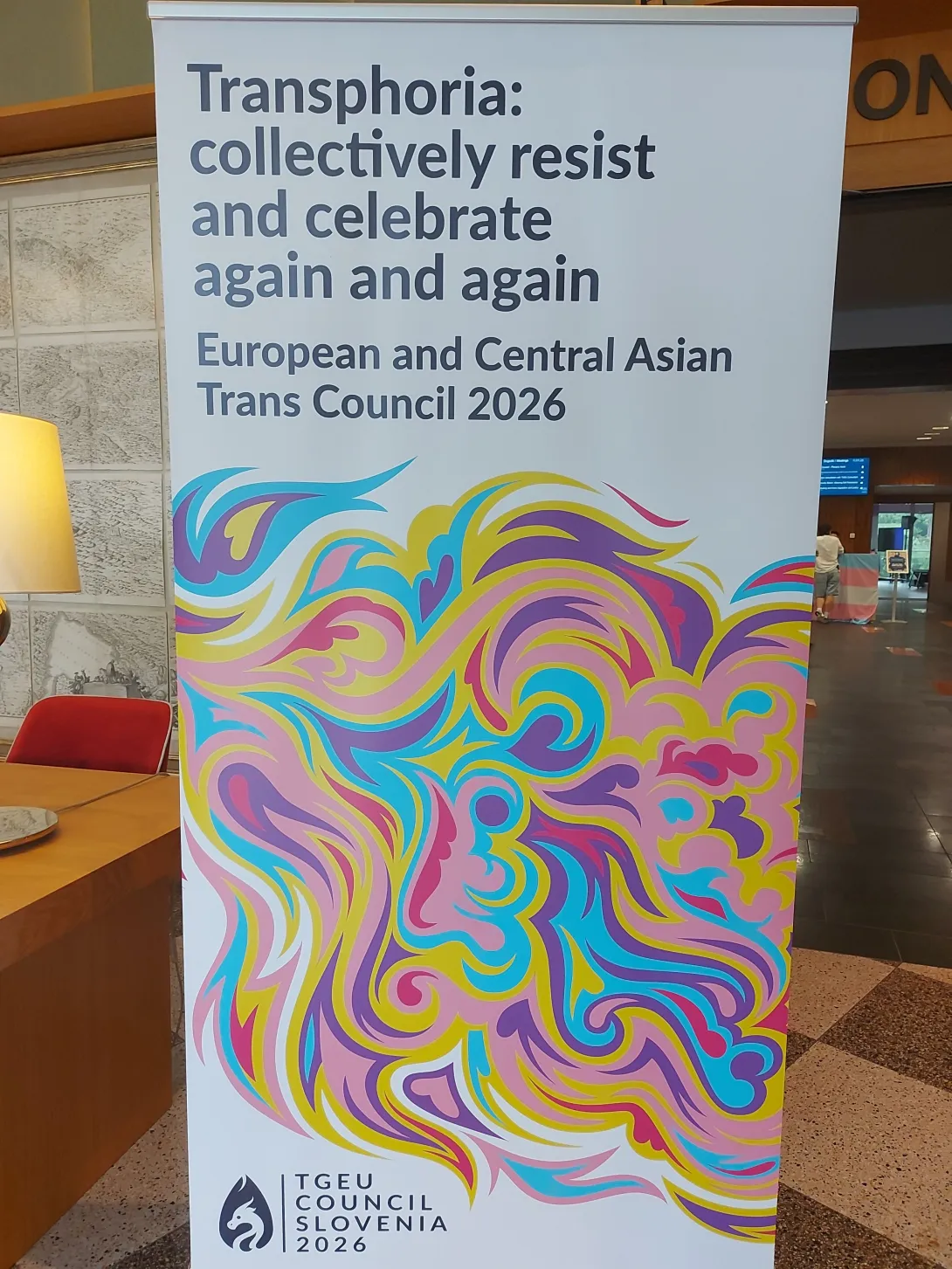
The International Trans Council of Trans Europe and Central Asia in Ljubljana
From 11 to 13 October 2026, the 10th International Council of Trans Europe and Central Asia (TGEU) took place in Ljubljana, Slovenia, attended by 200 trans activists from across Europe and Central Asia. Prior to this, on 9 and 10 October, a pilot seminar was held by the Council of Europe’s Sexual Orientation, Gender Identity and Expression and Sex Characteristics (SOGIESC) Unit on strategic litigation on LGBTIQA+ issues before the European Court of Human Rights, co-organised with TGEU, ILGA-Europe and the European Implementation Network.
In this article, I would like to share my impressions and reflections on these two events.
Strategic Litigation
I arrived in Ljubljana late in the evening on 8 October at the hotel where the two events were held. The pilot seminar began early the following morning. There were perhaps 20 of us, probably from around 15 countries. Some were lawyers, others were policy advocates working for LGBTIQA+ or trans NGOs, and others were simply activists, like me, although I have conducted my own strategic litigation to secure my ‘X’ gender marker in Spain.
The first day focused on the process of strategic litigation. What makes a case a strategic litigation case? What needs to be taken into account, beyond strictly legal issues? What are the requirements for bringing a case before the European Court of Human Rights?
We discussed how important it is to place the person or people affected who are pursuing the case, and their needs, at the centre. A person involved in strategic litigation does not always wish to be in the public eye, and there are ways to maintain their anonymity. Even so, what support – including psychosocial support – might those involved in the litigation need? How can they be protected from harassment, should it occur? In my own case, my friends were my main source of emotional support, as I pursued the case without publicity until a favourable and final judgement was reached. But it does not always have to be that way.
How can support be organised by groups or NGOs? What about the funding for strategic litigation, the costs of lawyers and court fees?
Sometimes it seems better to handle the legal side more discreetly; at other times, the entire legal process is laid out publicly. In any case, how can we support strategic litigation with political advocacy or street action?
We also reviewed the case law of the European Court of Human Rights on LGBTIQA+ issues: the legal recognition of gender identity (limited to a binary recognition, and still inadequate), same-sex marriage, the right to adoption, the right of association and peaceful assembly, and hate crimes and the state’s responsibility to act in cases of hate crimes. In 2024, ILGA Europe produced a publication on the relevant case law from both the European Court of Human Rights and the Court of Justice of the European Union.
This first day was quite action-packed, with participants from various countries sharing their litigation experiences. We also worked on litigation strategies in small groups during the afternoon.
We heard an important warning from a trans participant from the UK. For Women Scotland and Sex Matters, the two main TERF organisations in the UK that secured the transphobic ruling from the UK Supreme Court in April 2025, are now expanding into Europe. It is to be expected that they will attempt to take their transphobic propaganda to the European Court of Human Rights. If you still buy books by J.K. Rowling, the main funder of the TERFs at For Women Scotland, perhaps now is the time to start boycotting her and her works.
The second day focused on the aftermath of a ruling by the European Court of Human Rights. What is the process for monitoring compliance with the ruling within the framework of the Council of Europe? How can NGOs get involved in this process?
We learned that this process is, in fact, a political one, carried out by the Committee of Ministers of the Council of Europe. This is the area of expertise of the European Implementation Network, which has published a checklist for civil society on how to support the implementation of European Court of Human Rights judgments at national level.
For me, the first day was the most interesting and useful. Personally, I do not intend to engage in advocacy with governments, as this is not my way of doing politics. I am more of a street activist, favouring direct action or civil disobedience, and grassroots campaigns. In this sense, the pilot seminar has made me reflect on what my role might be in strategic litigation, particularly in supporting such a case. In my experience, both in my own litigation and in other ongoing cases in Spain, it has been – or continues to be – the lawyers who prefer a ‘silent’ litigation, and I wonder if it has to be that way. I understand the argument is not to ‘politicise’ the justice system, but, in fact, the justice system in Spain is already quite politicised. However, conducting our cases quietly does, in a way, protect us from attempts by TERFs or the right to influence the outcome of the proceedings. Nevertheless, I would like to see a debate – not only amongst lawyers, but also amongst activists – since, from my perspective, litigation strategies should be both legal and political. This remains an open question.
The International Trans Council of Trans Europe and Central Asia
The seminar was immediately followed by the TGEU International Council, which began with a small event on Thursday afternoon – which I skipped to look after myself. I preferred to have a long bath as a form of self-care, as I was lucky enough to have a bath in my room. Also, after two very intense days, I didn’t have the social energy for another event. So, a hot bath and an early night were what my body was asking for.
‘International Council’ sounds like a decision-making body within an organisation’s structure, but that wasn’t the case. The TGEU International Council is simply a gathering of trans people – binary and non-binary – from across Europe and Central Asia, with the aim of exchanging experiences, supporting one another, but also of building networks and community, enjoying a trans and non-binary space, and living a few days without fear. A few days of ‘transforia’ and celebration, as the gathering’s slogan put it. The latter is perhaps even more important for trans activists from countries such as Azerbaijan, Kyrgyzstan, Romania, Russia, Turkey, … Listening to their stories, you realise that our realities in countries such as Spain, Portugal, Germany, … aren’t so bad after all. I don’t mean to suggest that we can stop fighting – there’s still a long way to go before we can live without anxiety and have our rights fully recognised – but there are far more difficult situations out there, which we probably can’t even begin to imagine.
The Council began with a morning of plenary sessions. For me, there were too many plenary sessions. Isa Nico Borelli (she/her), chair of the TGEU executive committee, said: “This year’s Council theme, ‘Transphoria’, brings together resistance and celebration. We resist so that we may live, and we live to celebrate. It is no coincidence that our communities are the pillars of the struggle for human rights. What at first seems disruptive — our way of challenging scarcity, borders and limits — soon becomes undeniable. We continue to insist on what is vital: housing, food, healthcare, work, accessibility, citizenship and freedom of movement, which are not privileges, but preconditions for any kind of life. There is always a tension between wanting to walk away from what hurts us and choosing, once again, to stay. And coming together in this context means saying: ‘We are here to stay.’" She said so much more, and the truth is that her talk brought me to the brink of tears; it moved me deeply. And it wasn’t the only talk that did so. I don’t know if I was feeling particularly vulnerable during those days – perhaps I was.
This isn’t the place to go through the entire programme. Nor is it my aim to produce a report on the meeting. Rather, I want to share my impressions.
We then listened to an intergenerational conversation between a young trans activist – Tayri Fadil (she/her) – and an older trans activist who had already taken part in the first TGEU International Council 20 years ago – Sara Phillips (she/her) – about how to maintain our energy and look after one another.
The afternoon was devoted to parallel workshop sessions, and I attended a workshop on the exclusion of trans people from access to housing. We noted that there is very little specific data on trans people experiencing homelessness, or on discrimination in access to housing – something we had already discovered whilst preparing a submission to the European Commission on the issue of housing. But we know from experience that many of us lead precarious lives, and housing problems are part of this.
I decided to give the second half of the afternoon a miss, as I’d run out of energy. I needed to be on my own, read, listen to music, switch off – look after myself. On Friday evening, I didn’t go to the cultural programme either, as I couldn’t imagine managing to stay in a room with 200 people. To be honest, I was probably already in bed by around 10pm.
Saturday began with two plenary sessions, and I didn’t attend either of them. I made use of the quiet room to write in my diary and do a bit of preparation for my contribution to another workshop that afternoon. I rejoined the programme for the block of parallel workshops. I went to the ‘Transforia Archives: Stories of Resistance and Celebration’ workshop, a creative session involving collages, texts and drawings celebrating our resistance and existence.
The first session in the afternoon was also the workshop I was due to speak at: Non-binary futures: needs and perspectives. The workshop used a ‘fishbowl’ format; that is, it began with a few people in the centre sitting in a circle of chairs, but then people from the surrounding circles could take the place of those in the centre and contribute to the conversation. We began with non-binary people from Slovenia, Russia, Spain and Azerbaijan sharing our perspectives, but we were quickly replaced and people from other countries spoke. We ran out of time, which only served to highlight the need for spaces like this, where we can share experiences. I heard something similar later on about the workshop on sex work.
During the final afternoon session, I attended a workshop on TGEU in 2036. We split into different groups, and my group was tasked with imagining where we saw TGEU in 2036. We didn’t get much further than saying, ‘TGEU has survived the rise of the right as a membership-based organisation’. Perhaps other groups were somewhat more optimistic. However, a common theme across several groups was the need to strengthen the participation of member organisations and internal democracy – something we passed on to the TGEU executive committee and staff.
After such a long and intense day, I didn’t have the energy left for the evening party at a club in the centre of Ljubljana. I decided to look after myself and have a quiet evening at the hotel, and go to bed early.
By Sunday morning, the international council had come to an end. I wouldn’t dare attempt to summarise anything here. One issue that clearly emerged during the council is the need to strengthen community organisation, rather than focusing solely on strategic litigation and political advocacy – particularly in light of the rise of the far right in many European countries, and the state-sanctioned discourse promoting traditional family values and transphobia across much of Central Asia. Resilience – survival – requires community, and we must build these communities at local, regional, state/national and international levels.
Shortly before closing time, we received an example of this hostile climate – of how anti-gender movements – from the right and from various religious fundamentalist groups – have come to power: the raids on LGBTIQA+ organisations and the arrests of 162 activists and LGBTIQA+ people in Turkey during the night from Saturday to Sunday. In situations like this, international solidarity is needed, but so is a local community that can support the detained activists as well as their friends, families and networks.
I was deeply moved by the news from Turkey, perhaps also because I had worked for decades with anti-militarists in Turkey and had experienced similar situations, albeit not on the same scale.
In the end, it was time to say goodbye. But how do you say goodbye after an experience like that? Even with the difficulties I face in making connections due to my neurodivergence, I had made connections, I had spoken to lots of people from many different countries, and now saying ‘see you later’ or ‘until next time’ wasn’t easy. We’d spent a few days as part of a trans community, and now it was over.
On Sunday afternoon, having already said goodbye to most people, I went for a long walk into the centre of Ljubljana and back – three hours in total – which also gave me a chance to process my emotions and thoughts. To be honest, I wasn’t really able to enjoy Ljubljana’s historic centre, which, although very pretty, was packed with tourists, and I couldn’t stand the atmosphere. I returned to the hotel very early and had another long soak in the bath in my room. The next day I had to get up at 3.20 am to go to Ljubljana airport and fly back to Seville, where I arrived feeling very tired, not only from getting up early, but also from an intense week of meetings.
- Log in to post comments